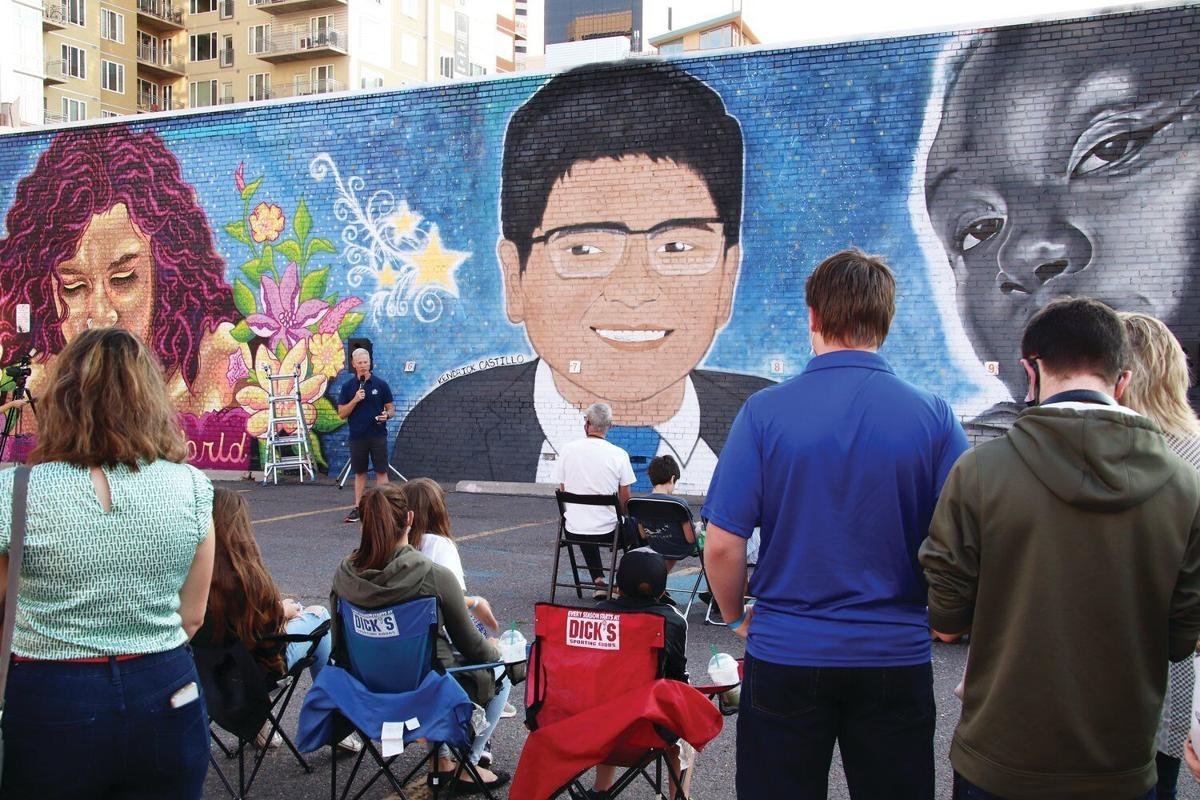
At the corner of 21st and Lawrence in Denver’s Ballpark neighborhood, a brick wall carries four faces and four stories. Kendrick Castillo. Mya Peña. Oluwatoyin Salau. Paul Childs. Each portrait was painted by a different artist, but they share a single purpose: to hold the memory of lives taken by violence and to refuse to let those lives be reduced to headlines.
The wall was curated by Colorado Street Art Company, which brought the portraits together as a unified memorial in the LAZ parking lot at 2100 Lawrence Street — a location chosen with care. The neighborhood is home to Samaritan House and other services for people in need, places that meant something to more than one person honored here. The wall looks out on movement and community rather than sitting behind closed doors.
The People on This Wall
Memorial Wall • 21st & Lawrence • Curated by Colorado Street Art
Curated by Colorado Street Art Company • Presented with support from La Popular Food Company
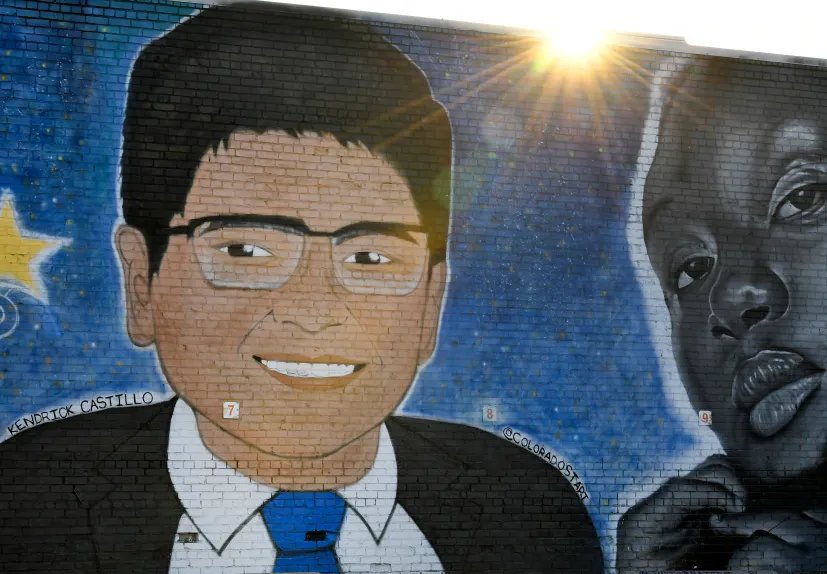
Kendrick Castillo
Kendrick was eighteen years old when he gave his life protecting classmates during the 2019 STEM School Highlands Ranch shooting. He rushed the shooter, giving hundreds of other students time to escape or take cover. His actions allowed them to go home that night.
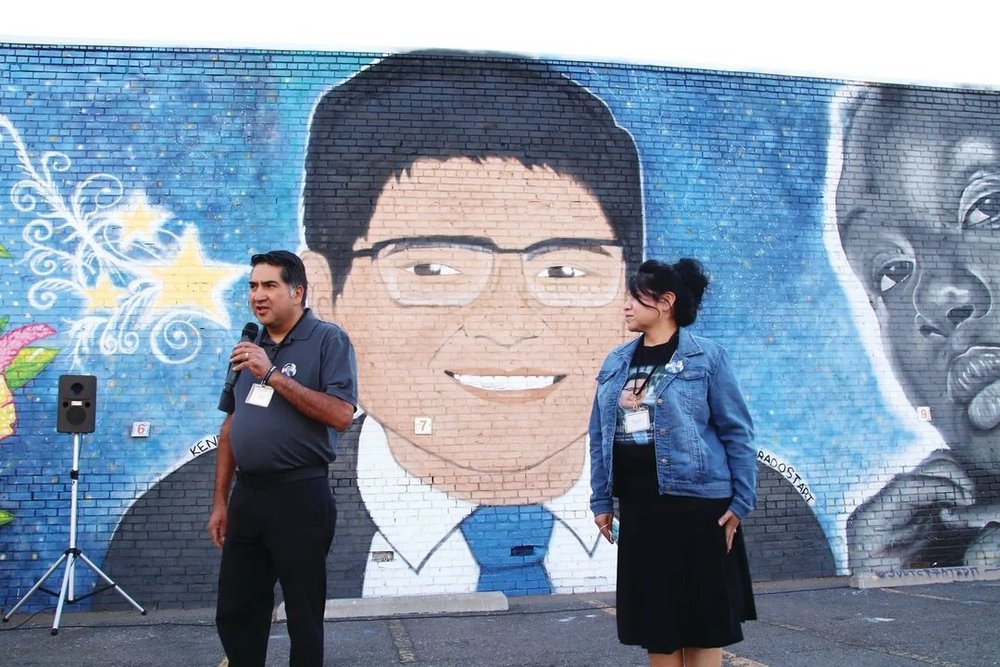
Colorado Street Art worked closely with Kendrick’s family to make sure the mural reflected who he really was — not just the act of heroism, but the person behind it. They chose an image of him smiling, glasses on, suit and tie sharp against a calm blue background. The location, just a few blocks from Samaritan House homeless shelter, was meaningful to his family. “That was really something Kendrick was passionate about, taking care of people and spreading his love,” his father John said. “I hope that when people are struggling, I just hope they look over and Kendrick’s looking down and providing comfort to them in some way.”
The unveiling on October 4, 2020, organized by community member Donna Vander Baan, drew about 30 people to the parking lot at 2100 Lawrence. John and Maria Castillo spoke. District Attorney George Brauchler, who prosecuted both accused STEM shooters, addressed the crowd: “There are family members, some of whom are here, who thank God for Kendrick Castillo because they don’t have to have a son or a daughter on a mural somewhere.” STEM student Lucy Sarkissian, then fifteen, spoke about her organization Cupcakes 4 Change — started after the shooting to support victims of gun violence. “Give a cupcake, it can make a world of difference,” she said.
For Colorado Street Art, the project came through a community suggestion and the answer was immediate. “We jumped right on it,” said Adam Clark. “We were really inspired by the story.”
Beyond the wall itself, Colorado communities have honored Kendrick in other ways. Douglas County renamed a stretch of Lucent Boulevard in Highlands Ranch to Kendrick Castillo Way — a reminder woven into the everyday map of the area he called home.
Mya Peña
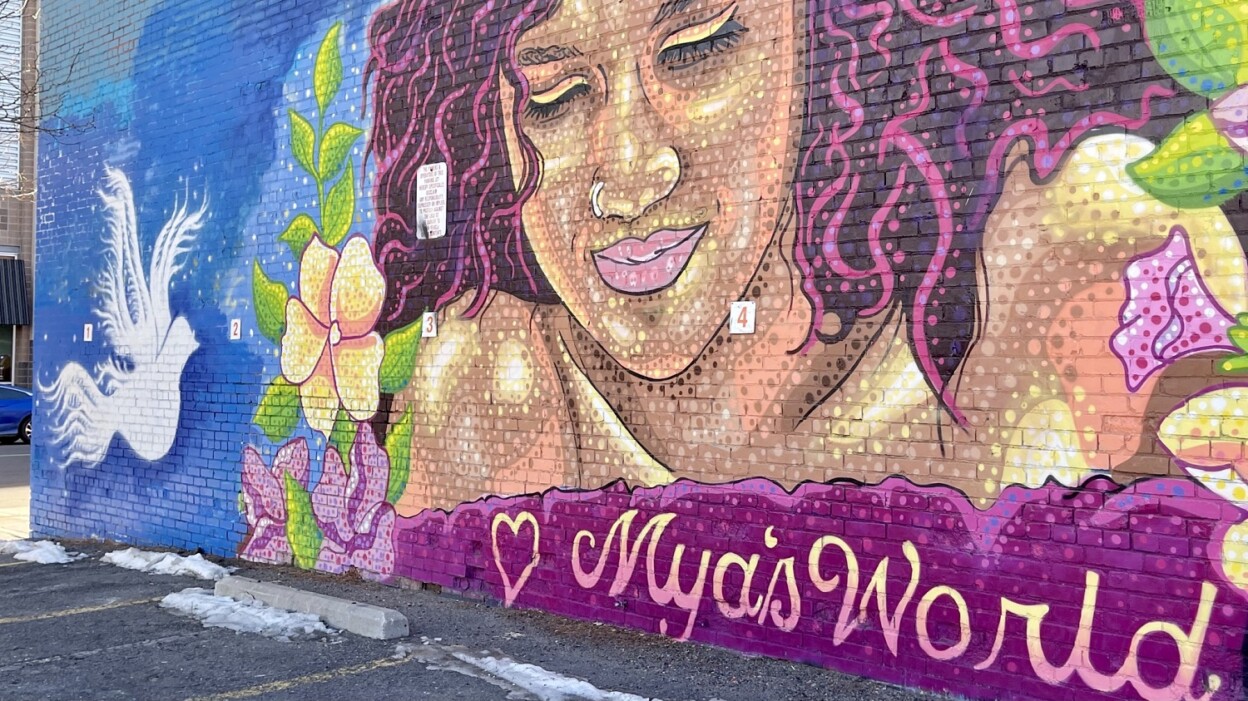
Mya Peña was seventeen years old and a student at Mile High Academy in Highlands Ranch when she was killed on January 14, 2020. She had befriended a young man she knew was struggling — someone dealing with serious mental health challenges — and was trying to help him. That afternoon, he took her life in a murder-suicide.
The people who knew Mya describe her in a consistent way: she was unusually kind, in a way that was deliberate and active, not just a personality trait. She saved part of every paycheck to buy food for people experiencing homelessness. She made friends with kids who didn’t have any. She noticed who was struggling and moved toward them rather than away.
“She had a heart for people who were less fortunate,” said her mother, Audra Peña. “She died because she was trying to be kind.”
Artist Austin Zucchini-Fowler painted Mya’s portrait at 21st and Lawrence — near the area downtown where she used to feed the homeless. Her family continues to gather at the mural on the anniversary of her death, bringing care kits for people in need and encouraging acts of kindness in her name. Her mother visits often. “I come here just to sit with her,” she said. “She looks over the city and that’s kind of what we’re proud of.”
In Mya’s memory, her family founded Mya’s World, an organization that provides support for young people dealing with domestic violence, unhealthy relationships, and mental health crises.
Oluwatoyin “Toyin” Salau
Oluwatoyin Salau — known to everyone as Toyin — was a nineteen-year-old Nigerian-American activist from Tallahassee, Florida. In the summer of 2020, she was a visible and passionate presence at Black Lives Matter protests in her city, speaking publicly and with urgency about justice, safety, and the protection of Black lives.
In the days before she was killed, Toyin shared on social media that she had been sexually assaulted by a man who offered her a ride. On June 15, 2020, she was found murdered. Her death sent waves of grief through activist communities across the country, with many pointing to the painful irony that a young woman who had marched for safety had not been kept safe herself.
Toyin’s portrait on the wall at 21st and Lawrence was painted by Giovannie “Just” Dixon. Her inclusion in this memorial is a recognition that the violence this wall stands against reaches beyond any single community or geography, and that her name — like all the names here — deserves to be spoken.
Paul Childs
Paul Childs was fifteen years old when he was shot and killed by a Denver police officer inside his own home on July 5, 2003. Paul had developmental disabilities, and his family had called police for help when he became distressed. When officers arrived, Paul was holding a kitchen knife. He was shot multiple times at close range.
His death sparked protests in Denver and forced a difficult public reckoning about how law enforcement responds to people with disabilities in mental health crisis — a conversation that cities across the country continue to struggle with. Paul’s family pursued accountability through the courts, and his name became part of a larger call for reform in how communities protect their most vulnerable members.
The portrait of Paul Childs, painted by Karlee Mariel and Robert Bowers, stands on this wall as a reminder that the obligation to protect young people does not end at the door of a home, and that accountability is a form of honoring the dead.
Art as a Stand Against Violence
The wall at 21st and Lawrence does not look away from hard things. Each portrait confronts the specific circumstances of a life ended by violence — a school shooting, a domestic violence murder, the killing of an activist, a police shooting in a family’s home. The differences in how each person died matter. So does what they shared: youth, a community that loved them, and a story that deserved more time.
For Colorado Street Art, murals like this one are about more than paint. They are about telling stories that might otherwise fade into headlines and anniversaries. A wall can become a shrine, a touchstone, a place where grief, gratitude, and hope exist together.
Visiting the Mural
The wall is in the LAZ parking lot at 2100 Lawrence Street in Denver’s Ballpark neighborhood, on the edge of Five Points. Cars come and go, games let out nearby, people walk to and from work or the shelters and services in the area. Above all that movement, four faces look out over the city.
It is worth taking a moment to stand there, look up at the wall, and remember the people it honors.
Visit the Mural
LAZ Parking Lot • 2100 Lawrence Street
Denver, CO 80205 • Ballpark / Five Points neighborhood
Media Coverage
- CBS Colorado — Kendrick Castillo Mural Unveiled →
- Rocky Mountain PBS — Mural Unveiled in Downtown Denver →
- KDVR Fox31 — Kendrick Castillo Mural Unveiled (Video) →
- Westword — Two New Denver Murals Dedicated to Fighting Violence →
- CBS Colorado — Mya Peña Identified as Victim in Murder-Suicide →
- KDVR Fox31 — Mya’s Mural: Remembering Murder Victims →
- 9News — Honoring Mya Peña’s Legacy of Kindness →
- Spectrum Magazine — Gone, Not Forgotten: Community Remembers Mya Peña →
- Video — Mya Peña Mural Tribute →